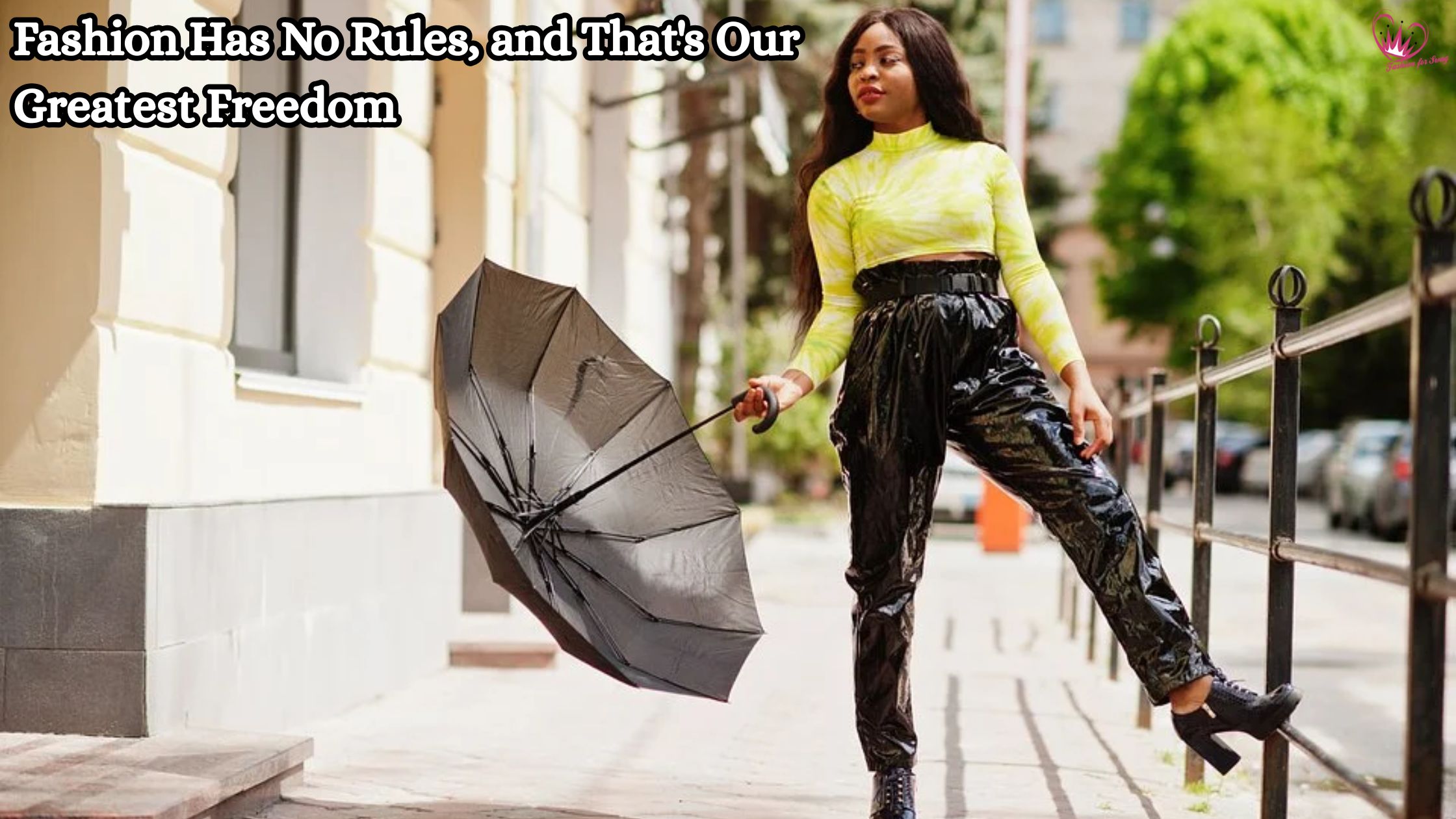
Fashion Has No Rules, and That’s Our Greatest Freedom
For centuries, fashion was a rigid fortress of rules, dictated by social class, gender conventions, and the seasonal pronouncements of a few elite designers. Women were told their hemlines must fall here, men were told their ties must have a knot, and certain colors were strictly prohibited after Labor Day. In this context, fashion was less about creativity and more about conformity – a silent, sartorial handshake that confirmed your place in society.
Today that fort has collapsed. The single, blanket judgments of the fashion elite have been replaced by millions of individual manifestos, fueled by global access, digital democracy and a radical cultural shift toward individualism. The most liberating truth in the modern wardrobe is simple, profound, and utterly empowering: fashion has no rules, and that is our greatest freedom.
This wide-ranging exploration highlights how the death of fashion rules has revolutionized self-expression, democratized style and fundamentally changed the way we navigate personal and public identities.
Dismantling the Old Guard: Where Did the Rules Come From?
To appreciate the freedom we have today, it’s helpful to take a look at the constraints that have defined the genre for generations. Fashion rules were, at their core, tools of social control and classification.
1. The Rule of Time and Place
- Seasonal Directive: The infamous “no whites after Labor Day” rule emerged from the aristocracy in the 19th and early 20th centuries, signaling that someone had returned from their summer vacation and was ready for the city’s sombre atmosphere.
- Trap of Opportunity: Strict dress codes (morning dress, afternoon tea dress, black tie) were non-negotiable markers of social standing. Deviance was seen as a serious social error.
2. The Rule of Gender
Until recently, clothing was one of the most visible tools of gender enforcement. Pants were for men, skirts were for women. The silhouette was rigidly defined: soft, flowing shapes for women; Sharp, structured lines for men.
3. The Rule of Body Shape
The widespread advice to “dress according to your body type” was not gentle guidance; This was often prescriptive advice designed to conceal, minimize, or adhere to a narrow beauty ideal. If you were “apple”, you couldn’t wear a belt; If you were a “pear”, you couldn’t wear horizontal stripes.
Rebellion against these rules isn’t just a trend – it’s a sociopolitical victory, allowing us to wear what we like, when we want and how we want.
The Pillars of Modern Fashion Freedom
The modern fashion landscape is built on four revolutionary pillars that celebrate individual choice above all else.
1. The Blurring of Gender Lines (Fluidity)
Perhaps the most impactful change is the rise of genderless or gender-fluid fashion. The movement rejects the premise that clothing should conform to binary identities.
- Action: We see cisgender women wearing finely tailored suits and oversized men’s apparel; Cisgender men are experimenting with makeup, beads, skirts, and traditional feminine clothing such as lace and silk.
- Freedom: It’s not just cross-dressing; This is the claim that clothing is clothing and size, not gender determining. When you separate clothes from biology, the entire wardrobe instantly doubles in size, and restrictive labels disappear.
2. High-Low Dressing (Democratization)
The rule that expensive clothing should only be paired with other expensive clothing, or that formal wear should be kept separate from casual wear, is obsolete.
- Action: Pairing a $5,000 designer blazer with thrift store denim and vintage sneakers. Wearing a voluminous ball gown skirt with a cropped graphic T-shirt. Mixing pearls with combat boots.
- Freedom: This approach signals confidence and creativity, proving that true style is about matching elements, not a price tag. This democratizes fashion, allowing individuals to use a designer piece as a stylistic accent rather than an overall uniform.
3. Seasonless and Occasionless Dressing (Autonomy)
The older patrons insisted on specific clothing and colors for specific months. Today we wear clothes not according to the calendar but according to our mood.
- Action: Wearing a pastel linen suit in winter because the color brings joy. Velvety and deep emerald green in summer. Wearing a full sequin dress to a casual dinner.
- Freedom: It gives autonomy to the wearer over the context. This rejects the industrial cycle of seasonal trends and allows clothing to become a source of pleasure year-round. Additionally, the COVID-19 pandemic accelerated the demise of “occasion wear,” even in high-risk environments with an emphasis on comfort and function.
4. The Celebration of ‘Wrong’ (Uniqueness)
The fear of clashing, mismatching, or making a “mistake” once paralyzed personal style. Now, deliberate struggle is the goal.
- Action: Intentional maximalism, clashing patterns (floral with stripes, polka dots with plaid), and wearing colors that don’t “go” according to the old rules (for example, mixing navy and black).
- Freedom: It is a celebration of individuality and complexity. It says, “My aesthetic is uniquely mine, and I reserve the right to define what is beautiful and what ‘works’ for my personal expression.”
The Therapeutic Power of Fashion Freedom
The abolition of rules offers benefits far beyond aesthetics. It offers a form of psychological liberation.
1. Enhanced Self-Acceptance
When you stop trying to wear clothes to hide a perceived flaw (following old rules about body shape) and start dressing to celebrate your unique geometry, clothes transform from a shield to a tool of self-love. The shift from “I should cover my hips” to “I love the way this skirt swings when I walk” is highly therapeutic.
2. A Tool for Identity Negotiation
We all play many roles: professional, parent, artist, friend. The freedom of fashion allows us to use clothing as a powerful, non-verbal tool to signal what identity we are choosing to occupy on any given day. A bold outfit for a presentation exudes confidence; Soft, layered clothing indicates creativity and spontaneity. This is called covert cognition – the systematic effect that clothing has on the psychological processes of the wearer.
3. The End of Gatekeeping
Since the rise of Instagram, TikTok, and global e-commerce, access to inspiration is limitless. The ability of a teenage trendsetter in Tokyo to impress a stylist in London overnight has shattered the traditional gatekeeping power of New York, Paris and Milan. In a world without rules, everyone is a creative director.
How to Fully Embrace the Freedom (Beyond the Rules)
Embracing this freedom requires a small shift in mindset: focusing on how clothes make you feel, not how they make you appear to others.
- Stop dressing according to your body type: Instead, dress according to your personality. If you like bold patterns, wear them from head to toe, regardless of the age-old advice that says they’ll make you “look wider.”
- Use the wardrobe as a playground: separate pieces that were once “sets” or designated for specific events. Pair a fancy silk slip dress with a chunky knit cardigan and a baseball cap. Play with scale (oversized shirts with micro-skirts) and textures (leather with chiffon).
- Find your uniform (then break it down): Create a personal uniform (e.g., structured blazer, wide-leg trousers, simple tee) that makes you feel confident. Once you have this base, introduce a “wrong” element—a shocking color, a silly shoe, or an old brooch—to signal your creative freedom.
Today’s greatest stylists—and the most influential people on social media—are the ones who look like they’re having the most fun. They’re not chasing trends; They are expressing their authentic, unique feeling. The liberation of fashion is a metaphor for broader cultural liberation: the right to define oneself outside of external pressure. Fashion has torn up the rule book, and in that beautiful void, we’ve finally found space to explore and confidently display who we really are.

Related Posts
Men’s Cocktail Attire: Mastering the Art of Striking the Perfect Balance
Y3K Fashion: The Future Is Here