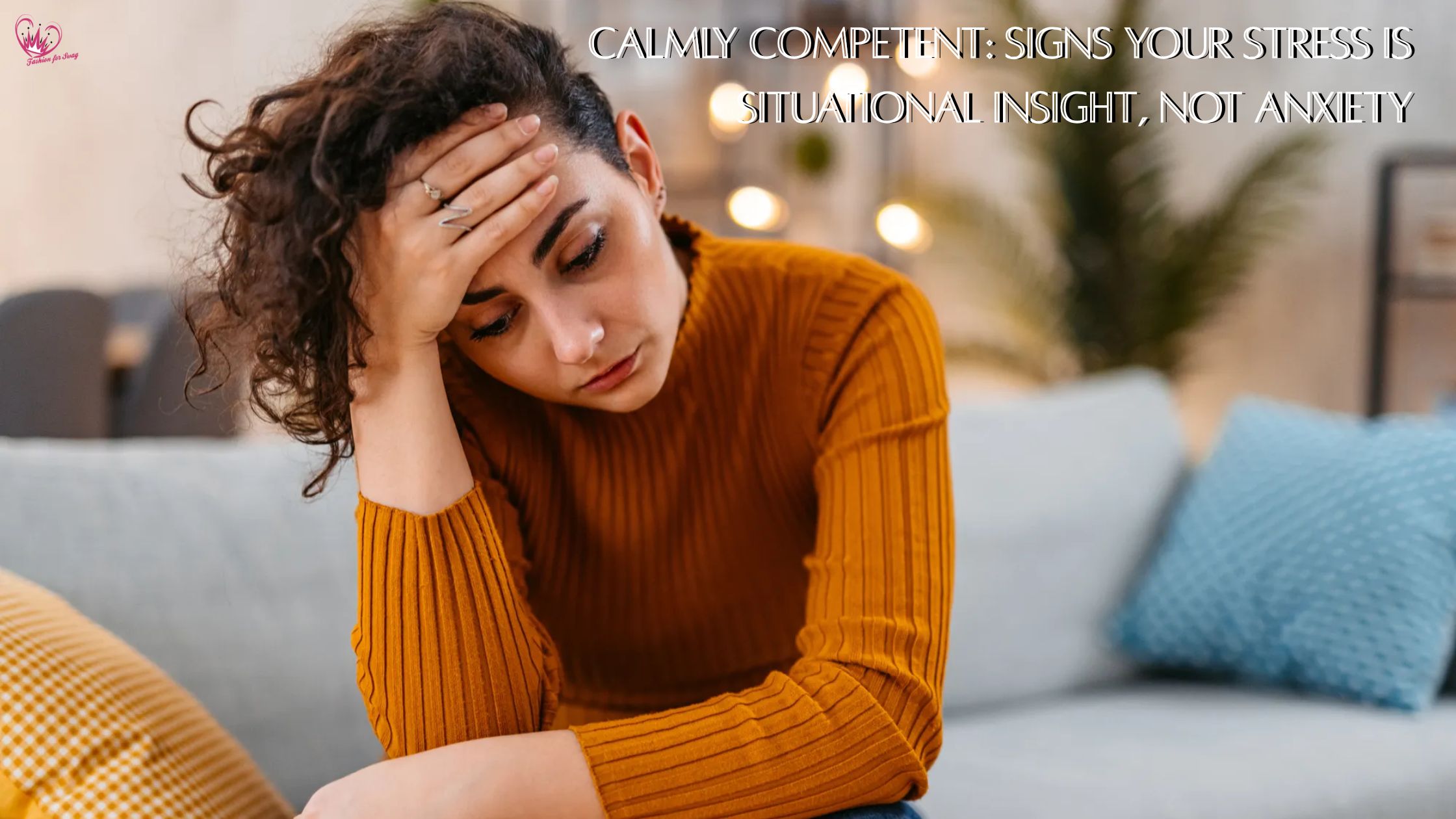
Calmly Competent: Signs Your Stress is Situational Insight, Not Anxiety
In the fast-paced, risky environment of contemporary life, the line between productive pressure and crippling anxiety often becomes blurred. Many individuals mistake this feeling of urgency (stress situational insight not anxiety), alertness, and focused mental energy for anxiety, leading them to unnecessarily classify high performance situations as a psychological burden. However, a vastly different, more adaptive state exists: quiet competence, driven by situational insight.
Situational insight is the rapid, clear-cut recognition of the complexity of a challenge, coupled with the focused mental resources needed to effectively address it. It’s the feeling of being “in the zone” under pressure. Yes, it’s stress, but stress acts as a cognitive accelerator rather than a psychological brake.
Understanding the fundamental difference between this positive, functional state of stress and real, debilitating anxiety is essential to optimizing performance, increasing mental flexibility, and accurately diagnosing your own emotional landscape. This distinction is not merely semantic; It is rooted in specific neurobiological and cognitive patterns.
The Neurobiological Dichotomy: Norepinephrine vs. Cortisol Dominance
The human body’s stress response is designed for survival using a group of hormones and neurotransmitters. The difference between calm ability and anxiety is that chemical pathways dominate the response.
The Competent Brain: Norepinephrine (Focus and Drive)
When experiencing situational insight, the brain primarily uses norepinephrine (NE) and, to a lesser extent, regulates the release of dopamine. This mechanism is important for the “fight or flight” response but is used functionally in competence:
- Increased alertness without jitters: NE acts as a neuromodulator, increasing the signal-to-noise ratio in the prefrontal cortex (PFC). This means that the brain filters out irrelevant stimuli and focuses on the task at hand faster.
- Optimal stimulation (Yerkes–Dodson law): The physiological state falls in the middle ground of the Yerkes–Dodson curve – a state of optimal stimulation where performance is maximized. Heart rate may increase slightly, but breathing remains steady and deep.
- Functional brain networks: In this condition, the central executive network (CEN) and salience network (SN) are highly activated and coordinated, while the default mode network (DMN) – a network associated with self-referential thinking – is suppressed. The brain is dedicated to doing, not worrying.
The Anxious Brain: Cortisol (Distress and Overload)
Anxiety, especially chronic or debilitating anxiety, is characterized by the prominent role of the stress hormone cortisol.
- HPA-axis overdrive: Cortisol is released through the hypothalamic-pituitary-adrenal (HPA) axis. Although necessary in short bursts, sustained high levels of cortisol impair cognitive function.
- Cognitive impairment: Excessive cortisol impairs working memory, inhibits neurogenesis in the hippocampus (important for memory and learning), and floods the amygdala, leading to over-activation of threat assessment.
- Brain network chaos: Anxiety is characterized by hyper-connectivity between the DMN and SN. This means that internal, self-referential thoughts (DMN) are constantly flagged as urgent and dominant (SN), trapping the individual in a self-perpetuating loop of worry and rumination.
Cognitive Markers: Clarity vs. Catastrophe
The internal dialogue and processing style are the clearest indicators of which state you are in.
The Cognitive Signature of Situational Insight
Situational insight operates with a bias toward clarity, specificity, and action-orientation.
- Specificity of anxiety: Stress is tied to a specific, controllable element of the situation. Example: “I need to make sure the data in cell B14 is accurate before the deadline.” Anxiety is a technical, solvable problem.
- Productive Distraction: The mind engages in “what if” scenarios, but these are quickly followed by “what then” solutions. Thinking is a gradual process of problem-solving and strategic planning.
- Enhanced working memory: Under the influence of controlled NE, the brain retains and manipulates relevant information with high precision. You feel mentally sharp and able to connect complex variables.
- External center of focus: Attention is directed outward at the problem, environment, and steps necessary for resolution, rather than inward at personal failures or physical sensations.
The Cognitive Signature of Anxiety
Anxiety is driven by a bias toward ambiguity, destructiveness, and self-centeredness.
- Global or vague anxiety: Stress is diffuse, generalized and often associated with the outcome rather than the process. Example: “I’m going to fail at this whole project and lose my job.” This concern is a non-specific, catastrophic prediction.
- Repetitive thinking: The mind gets stuck in a cycle, repeating worst-case scenarios without moving toward a solution. The “what-if” lacks the latter’s “then-what.”
- Impaired working memory: Cognitive load is monopolized by anxiety, leaving fewer resources available for actual work. This results in “blaring out”, difficulty concentrating, and making simple mistakes.
- Internal locus of focus: Attention is directed inward toward the self – for example, am I doing this right? My heart is beating very fast. I must look nervous. Anxiety becomes the primary problem, overshadowing basic functioning.
The Experiential Difference: Action vs. Avoidance
The way the feeling translates into action is a powerful diagnostic tool. Calm Competence motivates; Anxiety inhibits.
The Behavior of Competence
Feelings of controlled stress often manifest as highly functional, goal-directed behavior.
- Sense of control: Despite pressure, the individual feels like the agent of his or her own actions. They’re reaction driven, not emotion driven.
- Active engagement: The immediate urge is to gather resources, clarify objectives, and begin work. The solution to this is a willingness to connect with the source of the stress.
- Momentum and Energy: Have a sustained, focused energy level. Heart rate may be high, but breathing is often unconsciously controlled, allowing steady, deep delivery of oxygen to the brain and muscles. This gives a feeling of flow.
- Post-event resolution: Once the task is completed, the stress immediately goes away. There is a feeling of relief and accomplishment, and the body returns to baseline without any extended “crash.”
The Behavior of Anxiety
Anxious states often lead to disorganized, counterproductive, or avoidant behavior.
- Feelings of helplessness: The person feels like a victim of his or her own emotions and situation. They consider the challenge heavy and insurmountable.
- Reactive or avoidant response: The urge to stop, avoid, seek reassurance, or physically withdraw from the source of stress. Energy is spent managing the emotion rather than solving the problem.
- Disorganized energy: Physical symptoms (shortness of breath, dizziness, muscle tension, heart palpitations) feel out of control and often lead to agitated, frantic, or paralyzed behavior.
- Post-event persistence: Anxiety persists even after the situation has passed. The individual continues to ruminate on perceived failures or worry about the next imminent threat, demonstrating the difficulty of the HPA-axis in turning off the cortisol response.
Physiological Indicators: The Body’s Language
While both states involve sympathetic nervous system activation, subtle physiological cues distinguish the two.
| Calm Competence (Situational Insight) | Anxiety (Maladaptive Stress) |
| Respiration | Deep, even, and consistent (though sometimes faster). Primarily diaphragmatic. |
| Muscle Tension | Targeted tension (e.g., focused grip on a tool or keyboard). |
| Pace | Rhythmic, purposeful, and sustained action. |
| Gastrointestinal | Minimal or no symptoms. |
| Sleep | May be temporarily disrupted due to excitement, but recovery is fast. |
The key takeaway here is functionality. In competence, the physiological activation serves the task; in anxiety, it undermines the task.
Leveraging Competence: The Path to Resilience
Recognizing that your current feeling of pressure is Situational Insight, not Anxiety, is the first step toward leveraging that energy for peak performance.
1. Re-Framing the Arousal
When you feel your heart beating faster, immediately engage in cognitive reappraisal. Instead of thinking, “I’m having a panic attack,” think, “My body is generating energy and focus for work.” This simple linguistic shift tells the PFC to classify the stimulus as arousing (a challenge) rather than as fear (a threat), which favors the NE pathway over the cortisol response.
2. Strategic Pausing and Mindfulness
The ability to stop and observe your cognitive state without judgment is the ultimate anti-anxiety tool. A moment of mindfulness can confirm if your DMN is running wild (anxiety) or if your CEN is executing a clear plan (competence).
- The “Five Second Rule”: Before reacting to a feeling of stress, pause for five seconds and ask: What specifically is the problem at this moment? If the answer is unclear, redirect to a specific, actionable step.
3. Deliberate Regulation of the Breath
Breathing is the quickest way to signal safety to the nervous system. By deliberately slowing and deepening the breathing (for example, box breathing – 4 breaths in, 4 breaths in, 4 exhale, 4 pauses), you activate the parasympathetic nervous system (the “rest and digest” system), which controls the flood of stress hormones. This intervention proves to the anxious brain that despite the pressure, the body is safe and in control.
Conclusion: Stress as a Signal, Not a Sentence
The state of calm competence is the embodiment of high-level human functioning – the ability to cope with complexity, feel appropriate urgency, and maintain cognitive and emotional control.
The feeling of pressure is not inherently anxiety; This is often a valuable sign that your environment is demanding the best of you. Situational Insight is signal that is processed through a flexible filter, resulting in clarity, focused energy, and problem-solving drive. Conversely, anxiety is a sign that is corrupted by worry, self-doubt, and destructive thinking. By learning to recognize the signs—obviously cognitive specificity, constant flow state, and functional physiological arousal—we can move away from treating all stress as a disease. Instead, we can harness stress as the powerful, natural resource it was designed for, affirming that true potential often lies with a calm, focused fire. The ultimate indicator of success is the ability to feel pressure without succumbing to panic, choosing insight instead of worry at all times.

Related Posts
The Power 9: Lifestyle Habits for Exceptional Longevity

The Midnight Oil: Why We Stay Up Late