
How Parents Can Teach Kids the True Meaning of Dussehra?
October evenings in India carry a distinctive pulse. The faint chill of approaching winter mingles with the fragrance of crushed marigolds, the crackle of microphone checks from nearby Ramlila grounds, and the aroma of hot jalebis bubbling at neighbourhood street corners. For children, Dussehra is an intoxicating carnival of wooden bows and suction-cup arrows, shiny paper crowns, and the thundering spectacle of sixty-foot effigies erupting into sparks across the local maidan.
Yet beneath the noise, the fireworks, and the holiday mood, a subtle disconnect often creeps in.
When you ask a seven-year-old today what Dussehra is about, the answer usually arrives in neat, binary soundbites borrowed from animated shows: “Lord Rama killed Ravana,” or “Good beats bad.”
It isn’t incorrect, but it is incomplete. If we reduce the epic tradition to an ancient superhero comic where the protagonist defeats the villain, children miss out on the deeply psychological and ethical wisdom our festivals were designed to teach. Dussehra—or Vijayadashami—isn’t merely an annual chronicle of a legendary battlefield triumph. It is a mirror held up to human nature, urging us to examine the battles happening inside our own minds.
How do modern parents bridge the gap between myth and life, translating timeless lore into grounded, emotional values kids can carry into their schools, playgrounds, and relationships?
1. Decouple “Evil” from Caricatures: The Anatomy of Ravana
Most children imagine Ravana as a cackling monster born to do harm. But portraying him purely as an evil caricature deprives children of one of the Ramayana’s richest moral dilemmas.
Start by telling your children who Ravana actually was before the battlefield of Lanka:
- He was a brilliant scholar, a master of the four Vedas and six Shastras.
- He was a profound devotee, an accomplished musician who played the veena, and an extraordinary ruler who built a golden kingdom.
- He possessed immense discipline and intellect.
Ask your child: “If he was so smart, talented, and powerful, why did he fall?”
This opens the door to discussing uncontrolled ego (ahankara). Explain that doing bad things doesn’t always come from ignorance; it often comes from being so proud of one’s talents that one stops listening to conscience, empathy, and counsel. It teaches kids that getting top grades, excelling at sports, or being popular doesn’t excuse cruelty or selfishness. Brilliance without humility creates chaos.
2. Decode the Ten Heads: Hunting the Monsters Within
Watching an effigy collapse into flames is exhilarating, but the physical act can easily turn into passive entertainment. Turn the symbolism inward by unpacking what those ten heads represent.
Rather than treating them as a biological oddity, explain that each head symbolizes an unbridled impulse:
- Kama (Uncontrolled desire / Greed)
- Krodha (Blinding anger)
- Moha (Infatuation / Blind attachment)
- Lobha (Selfishness / Possessiveness)
- Mada (Arrogance / Pride)
- Matsarya (Envy / Jealousy)
- Swartha (Self-centeredness)
- Anyaya (Unfairness / Injustice)
- Amanavata (Lack of compassion)
- Ahankara (Ego / The feeling that “I am above the rules”)
An Interactive Household Activity:
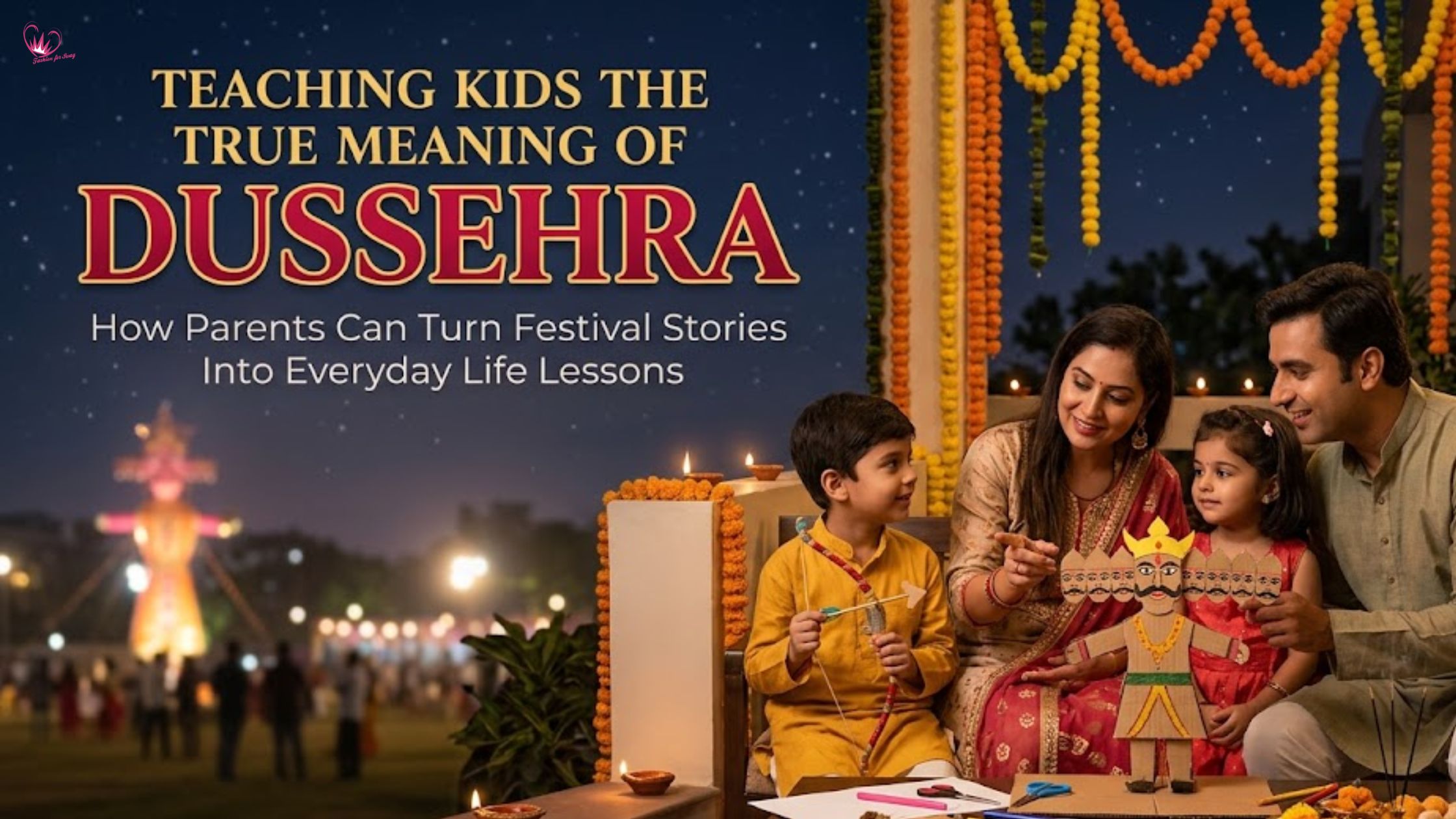
Instead of just buying firecrackers, sit down with some sheets of scrap paper the evening before Vijayadashami. Have your child draw a ten-headed figure or write down small habits they want to “burn away.”
It could be concrete, everyday things:
- “Throwing a tantrum when screen time ends.”
- “Feeling jealous when my friend wins a race.”
- “Speaking rudely to the household help or bus conductor.”
- “Refusing to share toys with my younger sibling.”
Write down a few of your own adult vices as well—whether it’s checking work emails at dinner or losing patience in traffic. Roll the slips together and burn them in a small earthen diya or toss them into the neighborhood bonfire. When kids see their parents participating in self-reflection, the ritual stops being a lecture and becomes a shared journey.
3. Introduce the Other Half of the Day: Goddess Durga and Inner Resilience
In many parts of India, particularly Bengal and Eastern states, the tenth day marks the culmination of Durga Puja: Vijayadashami, celebrating the victory of Maa Durga over the shape-shifting demon Mahishasura.
This aspect offers a priceless lesson in emotional balance and feminine strength:
- Mahishasura was a shape-shifter: Explain that wrong things rarely look evil from the outside. Peer pressure, bad influences, and toxic habits often disguise themselves as fun or normal.
- Durga represents combined collective strength: When the gods could not defeat the demon individually, they pooled their energy (Shakti) and weapons to create the Devi. Teach your children that asking for help and working as a team is never a sign of weakness—it is the highest form of courage.
Vijayadashami is also about courage in everyday life: standing up for a classmate who is being bullied on the school bus, admitting a mistake even when afraid of getting scolded, and having the integrity to say “no” when everyone else is doing something wrong.
4. Vidyarambham and Shami Puja: Respecting the Tools of Life
Down South and in western traditions, Vijayadashami is deeply intertwined with Ayudha Puja and Vidyarambham—the reverence of instruments and the initiation of knowledge. In Maharashtra, people exchange leaves of the Apta tree as gold (sona), wishing prosperity and goodwill to neighbors.
Use these rituals to teach two foundational life values:
Gratitude for Learning and Labor
Encourage your children to clean their study desk, organize their notebooks, sharpen their pencils, and wipe down their musical instruments or sports gear. Explain that any tool that helps you learn, grow, or earn a living deserves respect. Teach them to acknowledge the people who build and maintain our daily lives—our drivers, cooks, domestic cleaners, and security guards—by greeting them with sweets and genuine thankfulness.
New Beginnings Without Fear
Vijayadashami is considered the most auspicious day to start a new endeavor. If your child has been nervous about learning to swim, hesitant to read chapter books, or afraid of trying out for drama club, declare this day as their fresh start. Remove the pressure of perfection; frame it as an act of courageous beginning.
Bringing the Epic Home
Children learn very little from moral lectures recited at the dinner table. They absorb the stories that move their imaginations and the behavior they observe in their living rooms.
When you hold your child’s hand this Dussehra as the effigy turns to ash, lean down and remind them: Lord Rama didn’t just win a kingdom; he protected his dignity and compassion through fourteen years of exile. Maa Durga didn’t fight for glory; she restored balance to the world. The real victory of Dussehra doesn’t take place on the dusty Ramlila grounds beneath the smoke of firecrackers. It happens every time a child chooses kindness over cruelty, honesty over an easy lie, and humility over arrogance. That is the light that never burns out.