
The Aesthetics of the Mind: How the Brain Processes Beauty
Have you ever stood before a massive canvas in a museum, caught the perfect crimson gradient of a breaking sunset, or listened to a piece of music so hauntingly perfect that it gave you goosebumps? In those split seconds, you aren’t just thinking “that’s nice.” You are feeling a profound, full-body shift. For centuries, philosophers and artists argued that beauty was a mystical, intangible force—something floating safely outside the realm of equations and anatomy. But over the last few decades, a fascinating subfield of neuroscience called neuroaesthetics has pulled back the curtain on our inner worlds. It turns out that when we encounter something striking, our brains initiate a lightning-fast, highly coordinated symphony of neural firing. Understanding how the brain processes beauty isn’t just a win for science; it changes how we understand our relationship with the world, our evolutionary past, and ourselves. Let’s break down the journey a beautiful object takes from your eyes and ears straight into the deepest, most ancient parts of your mind.
1. The Sensory Gateway: From Raw Data to Perception
Before a painting becomes a masterpiece or a landscape becomes breathtaking, it is nothing more than raw, chaotic sensory information. Your brain has to do the heavy lifting of translating pixels, light waves, and sound frequencies into a coherent mental picture.
When you look at a classic piece of architecture, light hits your retina, triggering signals that race down the optic nerve to the primary visual cortex at the back of your brain. Here, the brain acts like a meticulous digital artist. It breaks the image down into its barest components:
- Lines and angles
- Color gradients and contrast
- Motion and orientation
But raw data isn’t enough to trigger an emotional response. The brain passes this data forward along two primary pathways: the “what” pathway (the ventral stream), which identifies what the object is, and the “where” pathway (the dorsal stream), which maps its position in space.
If you are listening to a moving cello concerto, a similar breakdown happens in your auditory cortex. The brain catalogs pitch, timbre, and rhythm. At this stage, your mind is merely registering the environment. The magic happens when these basic properties match up with our hardwired evolutionary preferences. We are deeply attracted to specific visual cues like symmetry, fluid curved lines (which signal safety compared to sharp, jagged edges), and the recurring geometric patterns found in nature known as fractals.
2. The Neurochemical Engine: Beauty as a Dopamine Reward
Once your sensory cortices finish processing the basic shapes and sounds, they pass the baton to the brain’s emotional heart. This is where the true essence of how the brain processes beauty comes alive.
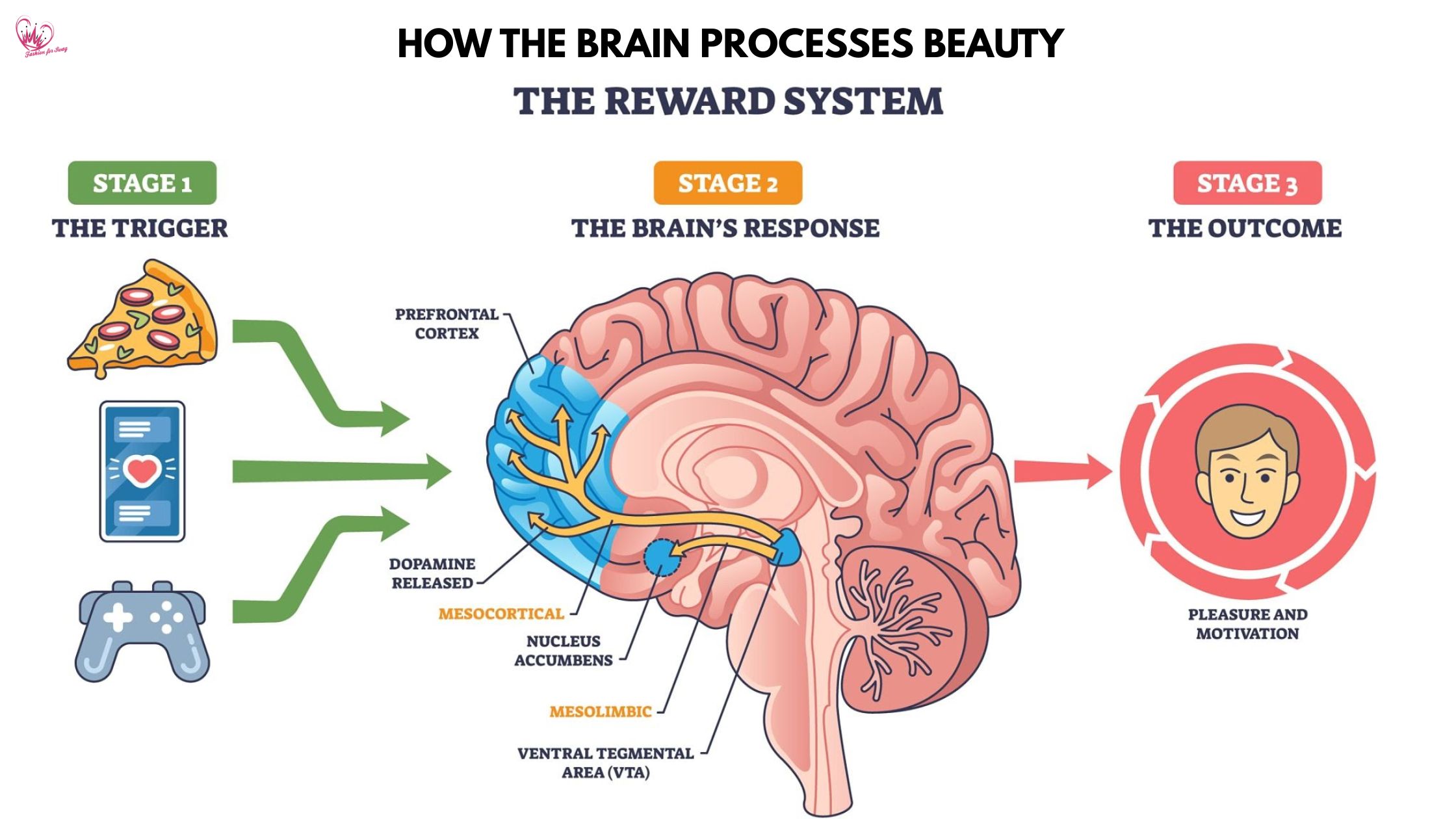
When you perceive something, you genuinely enjoy, it activates the exact same neural circuitry that fires up when you eat a rich slice of chocolate cake, win a bet, or fall in love: the brain’s reward system.
As shown in the pathway above, when a positive trigger is recognized, a wave of activity rushes through the medial orbitofrontal cortex (mOFC)—a region located right behind your eyes that acts as the brain’s primary beauty detector. Neuroscientist Semir Zeki famously demonstrated that no matter what kind of beauty you experience (a visual painting, a mathematical equation, or a brilliant musical composition), the mOFC consistently lights up in direct proportion to how beautiful you find the object.
This structural activation releases a cocktail of feel-good neurochemicals:
| Neurochemical | The Role It Plays in Aesthetic Appreciation |
| Dopamine | Spikes your anticipation, heightens your focus, and makes the experience feel deeply satisfying. |
| Endorphins | Soothes the nervous system, reduces physical tension, and induces a sense of calm. |
| Oxytocin | Triggers feelings of warmth, social connection, and intimacy, especially with narrative art. |
This reward loop isn’t an evolutionary accident. To our early ancestors, finding symmetry beautiful helped them identify healthy mates. Finding a lush, green landscape beautiful guided them toward fertile, safe environments rich in water and food. Our modern love for art is a glorious, complex spin-off of our basic survival instincts.
3. The Triad of the Aesthetic Mind
To better categorize this intricate process, neuroscientists look at the experience through a framework known as the Aesthetic Triad. This model, popularized by cognitive neuroscientist Anjan Chatterjee, suggests that your experience of beauty relies on three overlapping networks in the brain:
+————————–+
| SENSORY-MOTOR NETWORK |
| (Senses, Motion, Vision) |
+————-+————+
|
+———————–+———————–+
| |
+——-v——————+ +——-v——————+
| EMOTION-VALUATION NET. | | KNOWLEDGE-MEANING NET. |
| (Reward, Pleasure, mOFC) | | (Culture, Memory, Context)|
+————————–+ +————————–+
The Sensory-Motor Loop
This includes the sensory parts we discussed, but it also hooks into your motor control system. When you look at a dynamic painting with bold, sweeping brushstrokes (like a Vincent van Gogh piece), your mirror neurons fire. Your brain subtly simulates the physical movement required to create those lines, making you feel the kinetic energy of the artist.
The Emotion-Valuation Hub
This balances what you are seeing with how much pleasure it gives you. It links the visual signals directly to the amygdala (which handles intense emotions) and the insula (which ties emotional feelings to physical sensations in your body, like a racing heart or a lump in your throat).
The Knowledge-Meaning Filter
This is your personal background check. Your brain doesn’t look at art in a vacuum. It filters the experience through your memories, your cultural upbringing, and your explicit knowledge. If you are told a painting was created by an iconic master, your prefrontal cortex primes you to evaluate it more favorably than if you were told it was bought at a garage sale.
4. The Default Mode Network: When Beauty Becomes Personal
Have you ever looked at a piece of art and completely lost track of time? You feel a sudden, profound sense of peace and deep introspective clarity. This transcendent state happens thanks to a highly specialized neural network known as the Default Mode Network (DMN).
The DMN is a web of interacting brain regions that usually turns on when you are looking inward. It is active during:
- Daydreaming and mind-wandering
- Autobiographical memory retrieval
- Thinking about your own identity and future
Normally, when you focus on the outside world—like doing your taxes or driving a car—the DMN shuts down so your task-oriented networks can take over. But aesthetic experiences are unique. When you see a piece of art that moves you to your core, the task networks and the DMN light up at the same time.
This rare dual activation creates a bridge between the outside object and your internal sense of self. The beauty you are looking at outside becomes instantly woven into your inner personal history. It is why a song can feel like it was written explicitly for you, or why a painting can make you confront your own mortality. It transforms a simple sensory observation into a deeply moving, deeply personal event.
5. Objectivity vs. Subjectivity: Is Beauty in the Eye of the Beholder?
The ancient debate of whether beauty is objective (built into the universe) or subjective (unique to the individual) can finally be answered by looking at the brain. The truth is an elegant combination of both.
Our brains have objective baseline preferences written directly into our DNA. We universally lean toward clean symmetry, vibrant balanced colors, balanced compositions (like the golden ratio), and safe environments. These features send a clear signal of health, vitality, and order to our primitive minds.
However, the subjective filter of the Knowledge-Meaning network can completely override these settings. Your unique experiences shape the synapses of your brain over a lifetime. A harsh, dissonant piece of modern jazz might sound like pure noise to one person, lighting up their brain’s distress centers. To a trained musician, that same dissonance represents brilliant tension and resolution, sending their medial orbitofrontal cortex into a frenzy of delight.
Ultimately, how the brain processes beauty is a two-way street. Nature provides the foundational canvas, but your individual mind supplies the custom brushstrokes that determine exactly how that canvas makes you feel.
6. The Healing Power of Beautiful Spaces
Because our brains are so profoundly hardwired to react to beauty, our environments play a massive role in our daily mental well-being. Living and working in environments devoid of aesthetic care—dull, grey cubicles, harsh fluorescent lighting, and stark concrete architecture—can cause chronic, low-level stress. Without visual stimulation, the brain’s reward pathways remain quiet, leading to cognitive fatigue.
Conversely, integrating intentional beauty into your day acts as a natural neurological reset. Spending just twenty minutes walking through an art gallery, sitting in a beautifully landscaped park, or listening to a rich piece of orchestral music can systematically lower your cortisol levels, boost your working memory, and jumpstart your creative problem-solving skills. Beauty isn’t an elite luxury or a trivial distraction. It is a fundamental biological necessity—a vital mechanism our minds use to find joy, clarity, and deep connection in a complex universe.